The Enigma of Voroneț Blue
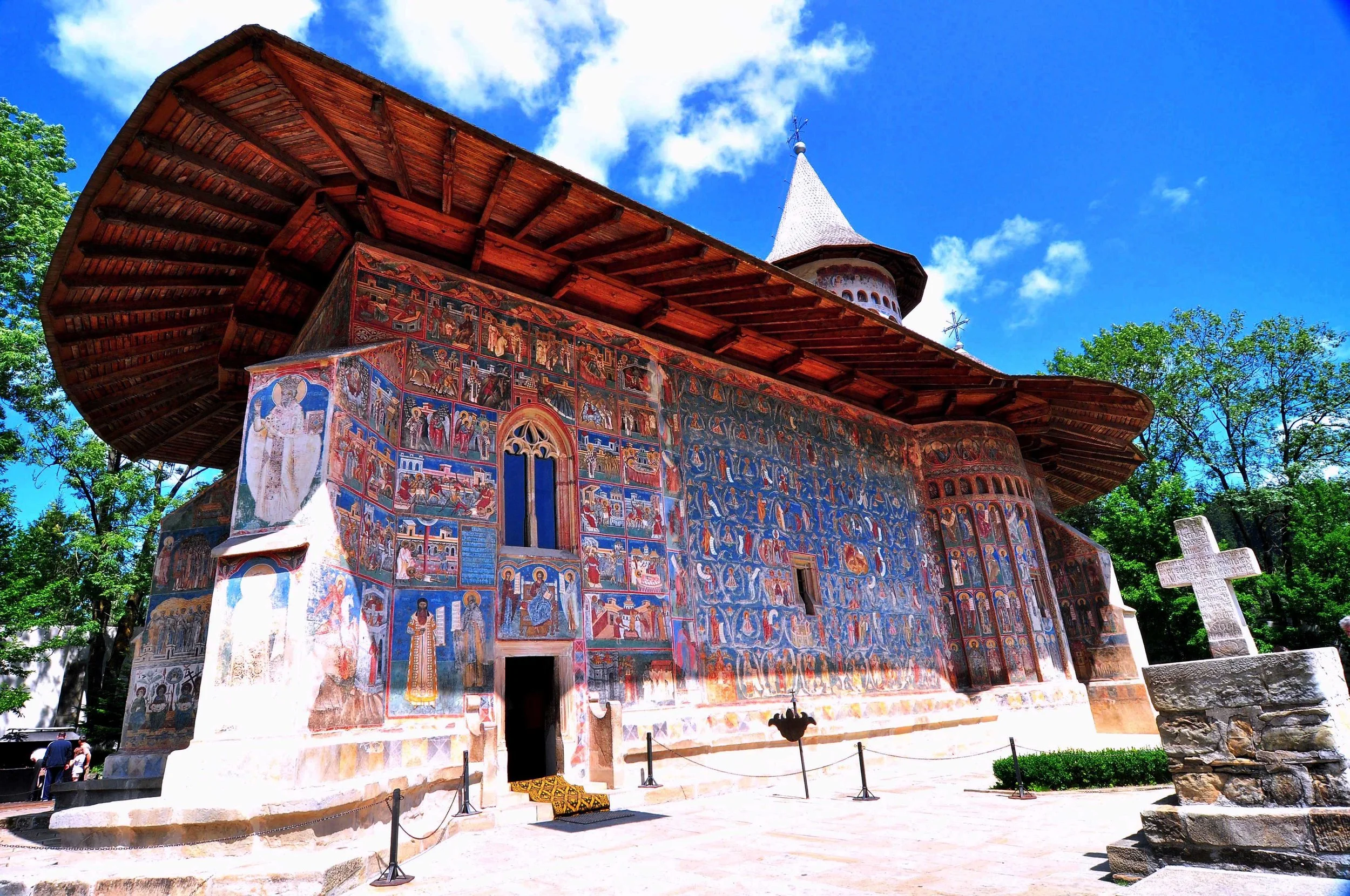
Manastirea Voronet foto: wikimedia Commons
The Remastered Sacred Blue: A Heritage Revived
"Voroneț Blue" is the hallmark term attributed to the breathtaking pigment found upon the frescoes of the Voroneț Monastery. Founded by the decree of Prince Stephen the Great and consecrated in 1488, the church was erected in a mere three months and three weeks—a breathtaking architectural feat that remains a record even by modern standards.
This legendary pigment was subsequently employed across the masterworks of Arbore, Humor, Moldovița, Sucevița, and Probota monasteries. This shared mastery reveals that the "zugravi" (the church painters of the era) were not mere decorators, but members of a highly sophisticated, applied school of painting.
The logistical mastery behind their work is nothing short of remarkable. More than five centuries ago—537 years, to be precise—these painters could not rely on art supply stores, for none existed. Instead, they held the profound knowledge required to forge their own reality: synthesizing local pigments, compounding binders, and hand-crafting their own brushes. A painter of that era was an intimate connoisseur of the natural world, engineering fine brushes from the delicate hair of squirrels, martens, bears, or wild boars.
Within this historical crucible, where church painters simultaneously embodied the roles of geologists, chemists, builders, hunters, artists, and explorers, emerges a rare pigment. Deeply rooted in Antiquity and chronicled in Ancient Greece and Rome long before the Middle Ages, this color traveled through the solemnity of Byzantine iconography to ultimately claim its eternal home upon the walls of Voroneț.
The lineage of this pigment is colossal. Its earliest codifications were penned by Cennino Cennini around the year 1400—a treatise of sacred knowledge that likely traversed borders to reach the master builders of Voroneț decades later.
As centuries unfolded, the physical-chemical enigma of this mysterious blue finally began to be unveiled in Romania around 1960. Collaborative teams of specialists from the "Nicolae Grigorescu" Institute of Fine Arts in Bucharest, the Institute of Atomic Physics in Măgurele, and the Institute of Chemistry of the Romanian Academy subjected the frescoes to optical microscopy, chemical analysis, and spectroscopy. Their findings led to a singular, monumental conclusion: Voroneț Blue owes its soul to a semi-precious stone—AZURITE.
To prevent a destructive chemical reaction with the wet lime plaster, azurite was applied a secco (on dry plaster) upon the Voroneț frescoes. Yet, its organic binder long remained shrouded in mystery. It is widely deduced to have been a gelatin derived from boiled bones, a casein extracted from milk whey, or a meticulous amalgamation of both. The true miracle lies in the pigment’s absolute stability against the erosion of time.
My own intimacy with this rare and precious pigment was forged during my tenure within the restoration team at Voroneț. It was deeply shaped by Mother Gabriela, the late Abbess of the monastery, and illuminated by the profound scholarly works of Professor Ioan Istudor—a master of ancient pigment techniques—alongside the guidance of Dinu and Cornelia Săvescu.
As a contemporary painter, my chosen medium is oil—a discipline vastly different from fresco painting. However, I have embraced azurite by adapting and personalizing these ancient, historical techniques. Azurite, as a living semi-precious stone, yields an extraordinary spectrum of blues depending on its particle granulation, the layering of glazes, and the choice of binders. Just as fresco demands its own specific mediums, translating azurite into oil painting requires an alchemy of honey, vinegar, natural beeswax, fine oils, Dammar varnish, and pure Venetian turpentine.
With profound reverence, I bow before the master craftsmen of the past. By weaving together medieval treatises with modern scientific insights, I seek to keep this living history and sacred tradition vibrant through my art. My paintings are, above all, an HOMAGE to their legacy.
"Voroneț Blue" may endure in urban legends as an impenetrable myth, but within my studio, its true mystery is honored through revival